
Artwork: Marcelle la Blonde by Juan Gris. Cleveland Museum of Art · Public domain
Four Chunking Strategies for Structured Documents in RAG
AI disclosure: This article was moderated by AI.
Chunking can determine whether a RAG system works well at all. Split too aggressively and a passage loses the context it needs. Split too coarsely and retrieval returns a wall of text when one paragraph would answer the query. Structured documents such as contracts, manuals, and OCR output with real headings need different strategies for different queries. We put four interchangeable chunkers behind one interface.
One interface, many strategies
Every chunker implements the same BaseChunker contract. The indexing pipeline does not need to
know which strategy is active:
class BaseChunker(ABC):
    @abstractmethod
    def chunk(self, content: str, metadata: dict[str, Any]) -> list[Document]:
        ...

    @property
    @abstractmethod
    def chunk_type(self) -> str:
        ...
A small factory maps a configuration string to an implementation, making the strategy a one-line change:
CHUNKER_TYPES = {
    "simple": SimpleChunker,
    "markdown": MarkdownChunker,
    "section": SectionAwareChunker,
    "semantic": SemanticChunker,
}

def get_chunker(
    chunker_type: str,
    chunk_size: int,
    chunk_overlap: int,
    breakpoint_threshold_type: str | None = None,  # semantic only
    embeddings_endpoint: str | None = None,        # semantic only
) -> BaseChunker:
    ...
Those five parameters cover everything the indexing pipeline needs. Changing "markdown" to
"semantic" in the configuration re-indexes the corpus with a different splitting algorithm and
requires no code changes.
The four strategies
1. Simple: character-based fallback
The simple strategy uses fixed-size character windows with overlap. It knows nothing about structure, but it is fast, deterministic, and a safe default when a document has no usable markup. It works best as a fallback rather than the preferred strategy.
2. Markdown: structure-aware with size limits
This strategy splits on Markdown structure, including headers, lists, and code blocks, while
respecting a chunk_size/chunk_overlap budget. It is the main choice for documentation and
other Markdown content. Chunks land on natural boundaries without exceeding the embedding
model’s context window.
The implementation uses LangChain splitters in two steps: headers first, then size. It defaults to a 1000-character chunk with 200-character overlap and splits on h1 through h3:
class MarkdownChunker(BaseChunker):
    DEFAULT_CHUNK_SIZE = 1000
    DEFAULT_CHUNK_OVERLAP = 200
    DEFAULT_HEADERS = [("#", "header_1"), ("##", "header_2"), ("###", "header_3")]

    def __init__(self, chunk_size=None, chunk_overlap=None, headers_to_split_on=None):
        self._markdown_splitter = MarkdownHeaderTextSplitter(
            headers_to_split_on=self.headers_to_split_on,
            strip_headers=False,  # keep the heading in the chunk for context
        )
        self._text_splitter = RecursiveCharacterTextSplitter(
            chunk_size=self.chunk_size,
            chunk_overlap=self.chunk_overlap,
            add_start_index=True,  # record each chunk's offset in the source
        )

    def chunk(self, content, metadata):
        header_splits = self._markdown_splitter.split_text(content)   # step 1
        final_chunks = self._text_splitter.split_documents(header_splits)  # step 2
        ...
The 20% overlap (200 of 1000) carries a sentence or two of context across a boundary. A passage
split mid-thought can still be retrieved from either side. With add_start_index, every chunk
records its character offset in the original document, which is useful for citations.
3. Section-aware: one chunk per section
Instead of enforcing a fixed size, this chunker keeps whole sections intact, with one chunk per
h1/h2. That suits high-level navigation, section-level search, and summarization. It detects
headers with a regex and splits further only when a section is genuinely oversized:
class SectionAwareChunker(BaseChunker):
    DEFAULT_SECTION_PATTERN = r"^(#{1,2})\s+(.+)$"
    MAX_SECTION_SIZE = 8000  # large, to preserve sections
Because a section can exceed the model’s window, oversized sections become paragraph-based fragments. Each fragment is tagged so retrieval knows that it belongs to a larger section:
chunk_metadata={
    "section_header": header_text,
    "section_level": len(header_level),
    "is_section_fragment": True,
    "fragment_index": len(chunks),
}
4. Semantic: split at topic boundaries
The semantic option embeds the text and places breakpoints where the topic changes rather than at
arbitrary character counts. Its configurable breakpoint algorithm can use percentile,
standard_deviation, interquartile, or gradient, and it calls a model serving endpoint for
embeddings. Use it when passages must remain topically coherent and the index-time embedding cost
is acceptable.
The defaults are a 2000-character ceiling and the percentile breakpoint method, backed by a
Databricks gte-large-en embedding endpoint. If embeddings are unavailable, the chunker falls
back instead of failing:
class SemanticChunker(BaseChunker):
    DEFAULT_CHUNK_SIZE = 2000
    DEFAULT_CHUNK_OVERLAP = 200
    DEFAULT_BREAKPOINT_THRESHOLD_TYPE = "percentile"
    DEFAULT_EMBEDDINGS_ENDPOINT = "databricks-gte-large-en"

    def chunk(self, content, metadata):
        raw_chunks = self._split_semantic(content)      # embedding-based
        if raw_chunks is None:                          # no embeddings / import error
            raw_chunks = self._split_fallback(content)  # RecursiveCharacterTextSplitter
        final_chunks = self._enforce_max_size(raw_chunks)  # re-split anything > 2000 chars
        ...
There are two safeguards. If langchain_experimental or the embedding credentials are missing,
the chunker falls back to character splitting rather than crashing the index job. Semantic
splitting can also emit a chunk far larger than expected, so _enforce_max_size splits any chunk
over the ceiling. The result uses semantic boundaries where possible while always enforcing the
size limit.
Metadata is the real payload
Chunk text is only part of the payload. Each chunk receives metadata that persists into the vector store, giving retrieval results their provenance:
enriched = {
    **base_metadata,
    **chunk_metadata,
    "chunk_index": chunk_index,
    "chunk_id": f"{doc_id}_{chunk_index}",
    "chunk_type": self.chunk_type,
}
The chunk_type field lets you A/B different strategies in the same index and attribute
retrieval quality to the chunker that produced each hit. The chunk_id provides a stable handle
for deduplication and citation.
Choosing a strategy
The four strategies produce indexes with noticeably different shapes. The following illustrative but representative comparison runs the same ~40-page equipment manual, roughly 90,000 characters, through each strategy:
| Strategy | Default size | Chunks produced | Avg chars/chunk | Index cost |
|---|---|---|---|---|
| Simple | 1000 / 200 overlap | ~110 | ~1000 | none |
| Markdown | 1000 / 200 overlap | ~95 | ~950 | none |
| Section-aware | 8000 max | ~18 | ~4700 | none |
| Semantic | 2000 ceiling | ~60 | ~1300 | 1 embedding call per sentence |
The table gives the counts, though the shapes are easier to remember:
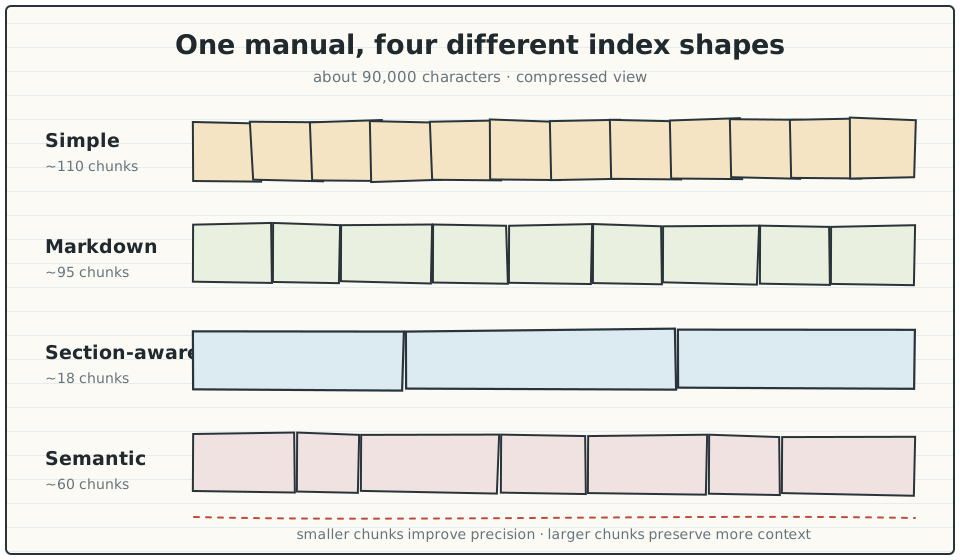
Section-aware produces ~6× fewer and ~5× larger chunks than simple splitting. That works well for “which section covers X” navigation but wastes context on pinpoint fact lookup. Semantic falls between the two on size and is the only strategy that incurs an embedding cost at index time. The query determines which trade-off makes sense:
| Strategy | Best for | Trade-off |
|---|---|---|
| Simple | Unstructured text, fallback | Ignores structure |
| Markdown | Docs, mixed content | Needs markdown input |
| Section-aware | Navigation, summarization | Large chunks |
| Semantic | Topic-coherent retrieval | Embedding cost at index time |
No chunker is universally best. The choice depends on the document shape and query pattern. Making the strategy configurable lets you measure retrieval quality for each option and choose based on the data without rewriting the indexing pipeline.
Takeaways
- Put every chunker behind one interface and select the implementation through configuration.
- Preserve structure, such as sections and headers, for navigational queries. Preserve topic coherence with semantic chunking for conceptual queries.
- Carry metadata such as
chunk_type,chunk_id, and section headers into the index so you can debug and attribute retrieval quality.