
Artwork: The Judgment of Paris by Lucas Cranach the Elder. The Metropolitan Museum of Art · Public domain
DeepEval vs Vally vs Waza vs convo-eval: A Technical Decision Guide
AI disclosure: This article was moderated by AI.
DeepEval, Microsoft Vally, Microsoft Waza, and convo-eval often appear in the same tool search,
but each evaluates a different object. Metric and feature counts are a poor basis for choosing among
them.
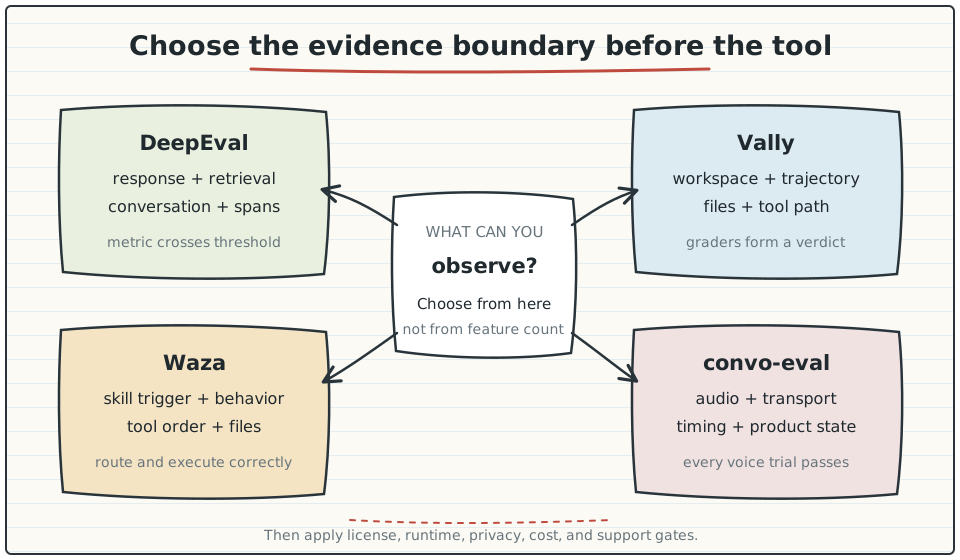
Start with the evidence boundary:
- DeepEval starts from LLM test cases, conversations, and instrumented traces.
- Vally starts from an agent task, isolated workspace, and normalized trajectory.
- Waza starts from an agent skill or custom-agent definition and asks whether it routes and behaves correctly.
convo-evalstarts from a deployed voice endpoint and retains transport, audio, transcript, tool, and persisted-outcome evidence.
The recommendation depends on the scenario:
| Requirement | Recommended framework | Confidence |
|---|---|---|
| General Python LLM, RAG, conversation, and agent evaluation | DeepEval | High |
| Declarative coding-agent and tool-trajectory evaluation | Vally, behind a version-pinned pilot | Medium |
SKILL.md trigger precision and skill-driven tool behavior | Waza | High |
| Deployed voice-agent endpoint regression | convo-eval architecture | High technical fit, blocked for public adoption |
This comparison covers DeepEval 4.2.0, Vally 0.14.0, Waza 0.38.7 with evaluation schema 1.2,
and the authenticated convo-eval source contract 0.1.0. The review snapshot is August 30, 2026.
Executive verdict
DeepEval is the default for Python-first teams that need broad coverage of responses, RAG, conversations, safety, and traced agents. It has the largest metric catalog and strongest public community in this group. In exchange, teams take on a large dependency graph, frequent judge calls, default telemetry, and a collaboration path tied to Confident AI.
Vally fits coding and tool-using agents whose correctness depends on both the trajectory and final workspace. Its declarative experiments, isolated environments, deterministic graders, offline re-grading, golden patches, and reporters make it the strongest general trajectory pipeline reviewed here. Adoption should remain cautious because Vally is pre-1.0 and its referenced public source repository was unavailable during review.
Waza fits agent skills. It has the strongest support for positive and negative trigger tests,
SKILL.md specification coverage, skill-invocation evidence, tool ordering, filesystem checks,
no-skill baselines, and cross-model comparison. It is neither a RAG evaluator nor a complete
multi-agent handoff evaluator.
The convo-eval architecture fits deployed voice endpoints that need repeatable audio
conversations, outcome probes, voice timelines, and retained WAV evidence. The inspected source is
not yet suitable as an external dependency because no public license or release exists.
Compare the unit under test first
Their native test objects make the differences easier to see.
| Framework | Native unit under test | Native evidence | Natural assertion |
|---|---|---|---|
| DeepEval | LLM response, conversation, agent trajectory, or traced component | Inputs, outputs, context, retrieval context, tools, spans | A metric score crosses a threshold |
| Vally | Agent execution in a prepared environment | ATIF trajectory, messages, tools, diffs, files, metrics | Graders aggregate to a verdict |
| Waza | SKILL.md, .agent.md, and skill-mediated execution | Trigger decision, skill calls, transcript, tools, files, usage | The skill routes and changes behavior correctly |
convo-eval | Deployed voice-enabled endpoint | PCM audio, voice events, transcript, tools, outcome state, traces | Every repeated voice trial satisfies critical gates |
Consider a support assistant that retrieves policy, invokes a refund tool, and speaks to the user:
- DeepEval can test answer faithfulness against retrieved policy.
- Vally can test the agent trajectory and resulting case workspace.
- Waza can test whether the refund skill activates only for eligible requests.
convo-evalcan test whether the deployed voice route understands audio, invokes the workflow, persists the refund state, and returns untruncated speech within an acceptable latency envelope.
These tests complement one another. Forcing one framework to own all four produces shallow coverage and awkward custom code.
Eligibility gates before scoring
Apply legal, runtime, security, and evidence gates before assigning feature scores. A weighted score cannot compensate for a failed eligibility requirement.
License and source gate
| Framework | License and source status | Eligibility implication |
|---|---|---|
| DeepEval | Apache-2.0 public repository | Eligible for normal open-source review and adoption |
| Vally | MIT package metadata and public docs; referenced source returned 404 | Package may be usable, but source-review and support requirements need resolution |
| Waza | MIT public Microsoft repository and signed release history | Eligible for normal open-source review and adoption |
convo-eval | No selected license, no public package, no public release | Ineligible as an external dependency |
Source without a license is not “free but unsupported.” Copyright applies by default. Without permission, external users should not assume rights to copy, modify, redistribute, or operate the code.
Runtime gate
| Framework | Primary runtime | Minimum or tested versions | Packaging model |
|---|---|---|---|
| DeepEval 4.2.0 | Python | Metadata supports 3.9 through 3.14 | PyPI package plus optional extras |
| Vally 0.14.0 | Node.js | Node 22.12.0 or newer | npm CLI, core, and server packages |
| Waza 0.38.7 | Native Go binary | Prebuilt macOS, Linux, and Windows binaries on amd64 and arm64 | Release binary; Go 1.26 and Git LFS for source builds |
convo-eval 0.1.0 contract | Python | CI targets 3.11, 3.12, and 3.13 | Authorized source checkout with uv; no public distribution |
A Python 3.10-only platform excludes the current convo-eval matrix, and a Node 20 build fleet
excludes Vally. Under a source-build-only policy, Waza’s embedded Git LFS dependency matters even
though most users can install a prebuilt binary.
Evidence gate
| Required evidence | DeepEval | Vally | Waza | convo-eval |
|---|---|---|---|---|
| Final text response | Native | Native | Native | Normalized transcript |
| Retrieval context | Native RAG test-case fields and metrics | Custom trajectory or grader data | Custom grader | External evaluator through interoperability export |
| Nested model and tool spans | Native tracing | Executor trajectory | Copilot execution transcript and tool records | External trace correlation, not internal graph ownership |
| Final filesystem state | Custom metric or test code | Native deterministic graders | Native deterministic graders | Not a core target |
| Skill invocation and anti-trigger behavior | Custom trace assertions | Skill graders available | Core specialization | Not a core target |
| Deployed HTTP endpoint | Application wrapper | Executor or custom environment | Agent execution context | Native turn-based adapter |
| Streaming WebSocket audio | Not native | Not native | Not native | Native adapter |
| Input, output, and mixed WAV artifacts | Not native | Not native | Not native | Native |
| Persisted business outcome after conversation | Custom metric | Grader or environment check | Program or custom grader | Native outcome-probe boundary |
No grader can recover evidence that was never observed. A rubric cannot determine whether audio clipped if the framework did not retain the audio.
Architecture comparison
The four execution models can be summarized as:
DeepEval
golden -> app invocation -> LLMTestCase / trace -> metric -> pytest verdict

Vally
stimulus -> isolated workspace -> executor -> trajectory -> graders -> report

Waza
skill + task -> workspace -> mock or Copilot executor -> behavior evidence -> graders

convo-eval
scenario + simulated user -> PCM -> deployed endpoint -> voice evidence + outcome -> gates
DeepEval architecture
DeepEval leaves application invocation under the test author’s control. The suite generates a
current actual_output, builds an LLMTestCase, and applies one or more metrics. Instrumentation
can add nested model, retriever, tool, and agent spans.
That flexibility works naturally with Pytest, but the team must design clean application fixtures
and tracing boundaries. Storing a stale actual_output as test data grades a fixture instead of
the current system.
Vally architecture
Vally owns more of the execution lifecycle. It prepares a workspace, invokes an executor, records a normalized trajectory, grades files and behavior, and saves results for offline re-grading.
Workspace state is first-class, which suits coding agents. The model is heavier than a row-based response test and depends on the selected executor capturing enough evidence.
Waza architecture
Waza combines task execution with skill discovery and injection. It records whether a skill was selected, whether that selection was correct, and whether execution improved over a baseline without the skill.
The baseline exposes regressions that absolute scoring misses. An answer can be acceptable while the skill makes the agent slower, less accurate, or more expensive.
convo-eval architecture
convo-eval hides product wire formats behind HTTP, WebSocket, fake, or custom endpoint adapters.
It generates canonical 24 kHz mono PCM16 input, drives turns, normalizes endpoint events, derives a
monotonic voice timeline, probes persisted state, and writes synchronized JSON and WAV artifacts.
Its boundary is the deployed endpoint. The product may use Agent Framework, LangGraph, an OpenAI SDK, custom orchestration, or no explicit agent framework at all.
Grader and metric comparison
Deterministic grading
| Framework | Deterministic path | Suitable critical gates |
|---|---|---|
| DeepEval | Custom BaseMetric, ordinary Pytest assertions, exact or structured comparisons | Schema, exact output, business invariants, custom trace checks |
| Vally | 32 of 34 reviewed built-in graders avoid judge calls | Files, diffs, output, tools, action sequence, budgets, programs |
| Waza | Rich built-in graders plus mock execution and MCP fixtures | Skill invocation, files, JSON, code, tools, ordering, budgets |
convo-eval | Topics, exit reason, outcome values, execution status, signal derivation | Contract phrases, completion, persisted state, provider health |
Vally and Waza provide the deepest built-in deterministic coverage for filesystem-changing
agents. DeepEval supports deterministic metrics, though semantic evaluation dominates its catalog
and product identity. convo-eval derives deterministic voice metrics, but the inspected
configuration does not expose every signal as a direct threshold gate.
Model-based grading
| Framework | Model-backed evaluation | Provider coupling |
|---|---|---|
| DeepEval | G-Eval, RAG, safety, conversation, agent, and many specialized metrics | Broad provider and local-model options |
| Vally | Prompt graders and judge panels | Agent and judge providers can be configured separately |
| Waza | Prompt graders and optional responder models | Copilot SDK execution route and compatible providers |
convo-eval | Azure OpenAI label graders plus task adherence, groundedness, and coherence | Azure AI Evaluation and Azure OpenAI |
DeepEval has the broadest semantic metric catalog. Vally and Waza treat model judges as one grader
class among many. In convo-eval, they are optional post-execution semantic checks over transcript
and tool evidence, not perceptual voice quality.
Repetition and flakiness
All four can participate in repeated evaluation, but their semantics differ:
- DeepEval repeats through Pytest, metric configuration, or external orchestration and can aggregate test runs in Confident AI.
- Vally records
pass@k,pass^k, and flakiness across agent executions. - Waza supports trials, attempts, multi-model execution, baseline comparison, and caching where safe.
convo-evalcomputespass@kand strictpass^kover complete voice trials with deterministic seeds for evaluator-controlled choices.
Use pass@k to ask whether any attempt solved the task. Use pass^k to ask whether every required
attempt passed. Reporting only the best attempt in a release gate hides instability.
Output provenance across this series
Terminal output can look authoritative even when it has been reconstructed. The articles therefore use three explicit evidence classes:
| Framework | Output evidence used | What it proves | What it does not prove |
|---|---|---|---|
| DeepEval | Documented result shape, clearly labeled as shortened representation | Expected metric result fields and CLI semantics | A successful local package run in this workspace |
| Vally | Locally observed version, lint, and mock-executor failure output | The installed package parsed and graded the supplied spec | Live Copilot executor quality |
| Waza | Repository-recorded guide output | Current task-reporting contract | Reproduction on the blog machine or equal model scores |
convo-eval | Authenticated repository tests and exact assertions | Fake WebSocket protocol order, artifacts, schemas, and pass contract | Public installability or live speech quality |
These provenance differences affect confidence. Source tests can prove deterministic contracts, but they cannot replace live provider trials, latency measurements, or perceptual listening.
Artifact comparison
| Framework | Local artifacts | CI and observability integration | Hosted path |
|---|---|---|---|
| DeepEval | JSON results and optional local trace inspection | Pytest, CLI exit codes, tracing | Confident AI reports, datasets, traces, online evaluation |
| Vally | JSONL, Markdown, JUnit, metadata, events, diffs, SQLite | JUnit, OpenTelemetry, local analytics server | External OTLP backend or organizational storage |
| Waza | JSON, JUnit, transcripts, NDJSON, snapshots, session logs | CI exits, OpenTelemetry, dashboard, optional Azure Blob | User-operated storage and telemetry backend |
convo-eval | Trial and run reports, JSONL voice events, transcripts, tools, raw events, three WAV channels | Exit codes, W3C trace correlation, versioned interoperability JSON | User-operated artifact and trace systems |
The most useful diagnostic artifact is the one closest to the native risk:
- DeepEval needs metric reasons and trace spans.
- Vally needs the trajectory, diff, and final workspace evidence.
- Waza needs skill-invocation records, tool events, baseline results, and snapshots.
convo-evalneeds normalized and raw events, latency timing, persisted outcomes, and listenable audio.
Set retention limits. Prompts, retrieved context, source files, tool arguments, transcripts, audio, and business outcomes can all contain sensitive data.
Dependency and operational burden
DeepEval
The mandatory Python graph includes Pytest, Pydantic, OpenAI, OpenTelemetry, PostHog, HTTP clients, gRPC, Rich, Typer, and concurrency-related plugins. This supports an integrated evaluation and tracing platform at the cost of longer installs, more lockfile movement, and a wider security review.
Vally
Vally requires a modern Node runtime and includes workspace lifecycle, Git integration, executor support, result persistence, OpenTelemetry, and reporting. It is a larger operational component than a metric library. Its default execution path also introduces GitHub Copilot SDK credentials and behavior.
Waza
The prebuilt Waza binary keeps runtime installation compact. Source builds are less conventional: they require Go 1.26 or newer, Git, Git LFS, and a repository clone containing embedded Copilot CLI artifacts. Live execution still depends on Copilot authentication or a configured compatible provider.
convo-eval
The base Python package supports local fake runs without cloud credentials. Extras add Azure OpenAI, Azure AI Evaluation, Azure Speech, or Voice Live. Live product tests also need endpoint adapters, authentication, service availability, and enough storage for PCM audio artifacts.
Cost comparison
An open-source license with no fee does not make evaluation free. Application execution, judge execution, infrastructure, artifact storage, and human review all contribute to cost.
| Framework | Main cost multiplier | Cheapest credible path | Expensive path |
|---|---|---|---|
| DeepEval | Test cases times judge-backed metrics and internal judge steps | Deterministic custom metrics with local JSON | Multiple semantic metrics plus hosted traces and seats |
| Vally | Stimuli times models times trials times judge panels | Mock executor plus deterministic graders and offline re-grading | Multi-model live agents with panel judges and environments |
| Waza | Tasks times trials times attempts times models times baseline | Mock executor, MCP fixtures, deterministic graders | Live Copilot models, no-skill baselines, responders, prompt judges |
convo-eval | Scenarios times personas times environments times trials | Fake endpoint plus scripted tone persona | Realtime persona, live voice product, semantic judges, WAV retention |
DeepEval hosted pricing snapshot
The DeepEval open-source package uses the Apache-2.0 license. At review time, Confident AI listed a free hosted tier, Starter at 2,000 per month, and custom Enterprise pricing. Provider model calls are billed separately.
Vally and Waza
Vally’s package metadata and Waza’s repository report MIT licensing with no listed framework fee. Agent execution is their main cost. Deterministic re-grading avoids paying for another trajectory while tuning a grader.
Voice evaluation
A live voice trial may incur charges for a simulated persona model, persona speech, product speech recognition, product reasoning, product speech generation, semantic judges, network use, and three audio artifacts. The test matrix grows multiplicatively:
where is scenarios, is personas, is audio environments, and is repeated trials. A 20 by 3 by 4 by 5 matrix already creates 1,200 conversations.
Privacy and data egress
| Framework | Default or common egress | Local control |
|---|---|---|
| DeepEval | Anonymous PostHog telemetry, judge providers, optional Confident AI upload | DEEPEVAL_TELEMETRY_OPT_OUT=1, local judge, omit cloud credentials |
| Vally | Usage telemetry enabled by default, agent and judge providers, optional OTLP | VALLY_TELEMETRY_OPTOUT=1 or DO_NOT_TRACK=1, local artifacts |
| Waza | Copilot/provider calls, prompt judges, update check, optional remote graders, OTLP, Azure Blob | Telemetry payload hashing by default, explicit payload opt-in, disable update check |
convo-eval | Product endpoint, optional Azure providers, outcome API, artifact and trace systems | Fake local path, optional extras, settings sanitization, custom adapter controls |
Disabling usage telemetry does not create a zero-egress evaluation. Judge calls still transmit evidence, and agent execution may transmit prompts, files, or tool context. Product endpoint tests intentionally send audio and data. OTLP exporters and hosted result systems add more boundaries.
For restricted workloads, map each field to every receiver:
prompt / scenario
  -> application model
  -> evaluator judge
  -> result artifact
  -> telemetry or trace backend

retrieved document / source file / opaque data
  -> agent context
  -> tool arguments
  -> grader context
  -> report or snapshot

audio
  -> speech provider
  -> deployed endpoint
  -> WAV artifact store
  -> optional perceptual evaluator
Apply synthetic data, least-privilege identities, encryption, redaction, and differentiated retention at each boundary.
Ownership, community, and support
| Framework | Maintainer | Public maturity signal at review | Support risk |
|---|---|---|---|
| DeepEval | Confident AI | About 17.9k stars, 1.9k forks, 308 contributors, 62 releases | Large active community, but backlog and rapid change; commercial plans available |
| Vally | Microsoft packages and documentation | Public source and normal repository signals unavailable | Pre-1.0 package requires a named support path and internal rollback plan |
| Waza | Microsoft public repository | About 1.3k stars, 79 forks, 15 contributors, 45 releases | Healthy specialist activity, no implied commercial SLA |
convo-eval | Microsoft-authored authenticated source | No public adopter or contributor base | No license or release; owner-only support boundary |
Repository stars are neither a quality metric nor an SLA. They indicate only how likely users are to find examples, prior issues, integrations, and upgrade experience beyond the maintainer team.
Technical decision matrix
The scores below use 5 for strong native support, 3 for support that requires meaningful
configuration or custom work, 1 for a weak fit, and 0 for unavailable or disqualified. This is
an architectural aid, not a benchmark result.
| Capability | DeepEval | Vally | Waza | convo-eval |
|---|---|---|---|---|
| LLM response metrics | 5 | 3 | 2 | 2 |
| RAG-specific metrics | 5 | 2 | 1 | 1 |
| General agent trajectory | 4 | 5 | 4 | 2 |
| Filesystem and diff grading | 2 | 5 | 5 | 0 |
| Skill trigger precision | 2 | 4 | 5 | 0 |
| No-skill baseline comparison | 1 | 3 | 5 | 0 |
| Deployed audio endpoint | 1 | 1 | 1 | 5 |
| Voice transport timing | 0 | 0 | 0 | 5 |
| Perceptual speech quality | 0 | 0 | 0 | 1 |
| Deterministic built-in agent graders | 2 | 5 | 5 | 3 |
| Broad semantic metric catalog | 5 | 3 | 2 | 2 |
| Public source adoptability | 5 | 2 | 5 | 0 |
| Public community depth | 5 | 1 | 3 | 0 |
Do not sum the table without weights and eligibility gates. Voice transport timing has no value in
a text-only RAG service, while RAG faithfulness has limited value when the main requirement is
whether a SKILL.md file triggers.
Reproducible selection policy
The following Python policy applies eligibility rules before ranking native fit:
from dataclasses import dataclass


@dataclass(frozen=True)
class Requirement:
    name: str
    runtime: str
    public_license_required: bool = True
    rag: bool = False
    trajectory: bool = False
    skill_routing: bool = False
    deployed_voice: bool = False


def select(requirement: Requirement) -> str:
    if requirement.deployed_voice:
        if requirement.public_license_required:
            return "BLOCKED: convo-eval fits technically but is not licensed"
        return "convo-eval"
    if requirement.skill_routing:
        return "Waza"
    if requirement.trajectory and requirement.runtime == "node22":
        return "Vally pilot"
    if requirement.rag or requirement.runtime.startswith("python"):
        return "DeepEval"
    return "Run a focused proof of concept"


requirements = [
    Requirement("rag-platform", "python312", rag=True),
    Requirement("coding-agent", "node22", trajectory=True),
    Requirement("skill-authoring", "native", skill_routing=True),
    Requirement("voice-regression", "python312", deployed_voice=True),
]

for requirement in requirements:
    print(f"{requirement.name}: {select(requirement)}")
The deterministic worked output is:
rag-platform: DeepEval
coding-agent: Vally pilot
skill-authoring: Waza
voice-regression: BLOCKED: convo-eval fits technically but is not licensed
The policy is intentionally simple. Before assigning weighted scores, an organization should add gates for source availability, approved providers, data residency, artifact retention, support, and budget.
Scenario decisions
Python RAG service
Choose DeepEval. Its native test-case fields distinguish context from retrieval context, and its metric catalog covers faithfulness, relevancy, precision, recall, safety, and custom criteria. Add deterministic assertions for citations, schemas, and business rules before using judge metrics.
Vally and Waza add unnecessary execution machinery unless the RAG system includes an agent that
modifies files or depends on skill behavior. convo-eval matters only when the service exposes a
voice path that requires separate testing.
Coding agent in a repository
Choose Vally when both the agent trajectory and final workspace matter. Its file, diff, tool-order, program, token-budget, and wall-time graders fit that problem directly. Offline re-grading and golden patches also help with evaluator development.
Choose Waza when the central question is whether one skill was selected and followed. When both concerns matter, Waza can cover skill routing and Vally can cover broader repository-task experiments. Confirm that the duplicate execution cost is justified.
Agent skill marketplace
Choose Waza. Each skill should have:
- Positive trigger prompts.
- Adjacent anti-trigger prompts.
- Specification coverage for instructions promised in
SKILL.md. - Required and forbidden tool assertions.
- Output and filesystem assertions.
- A no-skill baseline.
- Repeated trials across supported execution models.
DeepEval can judge the final answer, but it does not natively determine whether the skill activated correctly. Vally is a reasonable second choice when broader trajectory experiments matter more than Waza’s specialist workflow.
Deployed realtime voice agent
The convo-eval architecture is the only reviewed design that directly handles streaming audio,
endpoint adapters, PCM normalization, voice events, latency derivation, environmental mixing,
outcome probes, and WAV evidence.
The inspected package is not publicly adoptable. An external team has three choices:
- Wait for an approved license and immutable release.
- Build an internal harness from independently designed, licensed components using the same endpoint and evidence principles.
- Use a licensed commercial or open-source voice-evaluation product and export transcript or trace evidence to the general evaluator.
Whatever implementation you choose, add human listening or a specialized speech-quality system. Silence, clipping, and latency do not measure naturalness, pronunciation, intelligibility, or speaker similarity.
TypeScript-only organization
Vally has the clearest native fit if the organization accepts Node 22.12 or newer and the package’s source and support boundary. DeepEval’s TypeScript package showed registry and dependency inconsistency during review, so documentation parity is not enough; require a clean installation test before selection.
Waza can run as a native binary in a TypeScript repository. That language independence helps when the target is a skill rather than application code.
Air-gapped or highly restricted environment
Running locally does not exempt any framework from review.
- DeepEval needs local deterministic metrics or an approved local judge, telemetry disabled, and no Confident AI upload.
- Vally needs a model-free executor path or approved local provider, telemetry disabled, and local artifact retention.
- Waza needs pre-archived binaries, disabled update checks, mock execution or an approved provider, and no remote graders.
convo-evalneeds the fake endpoint or approved internal services and remains blocked by licensing outside authorized use.
Deterministic checks should dominate strict release gates in all four designs.
Layered evaluation architecture
Many production agents need more than one evaluator. Organize evaluation by failure layer rather than forcing every test into one schema:
Layer 1: deterministic unit and contract tests
  schemas, pure functions, tool contracts, persisted-state assertions
                           |
                           v
Layer 2: response and retrieval evaluation
  DeepEval test cases, RAG metrics, calibrated semantic checks
                           |
                           v
Layer 3: agent execution evaluation
  Vally trajectories and workspace graders
                           |
                           v
Layer 4: skill routing evaluation
  Waza trigger, anti-trigger, baseline, and tool-behavior tests
                           |
                           v
Layer 5: deployed channel evaluation
  licensed voice harness, HTTP/WebSocket audio, latency, outcome, WAV
                           |
                           v
Layer 6: production monitoring and human review
  traces, sampled online evals, incidents, perceptual listening
Few applications need every layer. A simple RAG API may stop after layer 2 plus production monitoring. A skill-driven coding agent may emphasize layers 3 and 4, while a regulated voice workflow may require all six.
Shared result envelope
Keep native artifacts and publish a small cross-framework summary for dashboards and release policy:
{
  "schema_version": "1.0",
  "suite_id": "refund-agent-release-2026-08-30",
  "framework": "waza",
  "framework_version": "0.38.7",
  "scenario_id": "refund-skill-eligible-request",
  "trial_id": "trial-003",
  "execution_status": "succeeded",
  "gate_status": "passed",
  "scores": [
    {
      "name": "required_skill_invocation",
      "value": true,
      "critical": true
    }
  ],
  "artifact_uri": "artifact://agent-evals/waza/trial-003",
  "trace_ids": ["4bf92f3577b34da6a3ce929d0e0e4736"]
}
Do not flatten native evidence into this envelope. It should point to DeepEval traces, Vally trajectories, Waza snapshots, or voice artifacts rather than replacing them.
CI staging
A practical pipeline separates inexpensive deterministic checks from costly live suites:
name: evaluation-layers

on:
  pull_request:
  schedule:
    - cron: '0 2 * * *'

jobs:
  response-evals:
    if: github.event_name == 'pull_request'
    runs-on: ubuntu-latest
    steps:
      - uses: actions/checkout@v4
      - uses: actions/setup-python@v5
        with:
          python-version: '3.12'
      - run: pip install 'deepeval==4.2.0'
      - run: deepeval test run tests/evals -n 1
        env:
          DEEPEVAL_TELEMETRY_OPT_OUT: '1'
          OPENAI_API_KEY: ${{ secrets.EVAL_OPENAI_API_KEY }}

  skill-evals:
    if: github.event_name == 'pull_request'
    runs-on: ubuntu-latest
    steps:
      - uses: actions/checkout@v4
      - run: ./tools/waza-0.38.7 run evals/skill.yaml --reporter junit:results.xml
        env:
          WAZA_NO_UPDATE_CHECK: '1'
          GITHUB_TOKEN: ${{ secrets.COPILOT_EVAL_TOKEN }}
      - if: always()
        uses: actions/upload-artifact@v4
        with:
          name: skill-eval-results
          path: results.xml

  nightly-agent-evals:
    if: github.event_name == 'schedule'
    runs-on: ubuntu-latest
    steps:
      - uses: actions/checkout@v4
      - uses: actions/setup-node@v4
        with:
          node-version: '22'
      - run: npm ci
      - run: npx vally@0.14.0 eval --eval-spec evals/agent.yaml --junit --output-dir results
        env:
          VALLY_TELEMETRY_OPTOUT: '1'
          COPILOT_GITHUB_TOKEN: ${{ secrets.COPILOT_EVAL_TOKEN }}
      - if: always()
        uses: actions/upload-artifact@v4
        with:
          name: nightly-agent-results
          path: results/
The example omits convo-eval deliberately. An unlicensed source package should not appear as a
normal public CI recommendation. Add a licensed voice harness in a separate scheduled or
pre-release job.
Common selection mistakes
Counting metrics instead of mapping risks
Fifty text metrics do not cover audio truncation, and a rich file grader does not cover retrieval faithfulness. Start with the failure modes and evidence you need.
Making every judge a critical gate
Model judges vary with model versions, prompts, sampling, and provider behavior. Calibrate them against human labels, repeat borderline cases, and use deterministic gates for contractual requirements.
Treating pre-1.0 versions as stable APIs
Vally, Waza, and convo-eval all expose pre-1.0 surfaces. Pin versions, archive schemas and
binaries, test upgrades, and preserve rollback paths.
Confusing local execution with privacy
Local orchestration may still send prompts, files, retrieved context, transcripts, audio, and tool evidence to providers. Document the complete data flow.
Ignoring evaluator validation
Validate the evaluators themselves. Vally supports golden trajectories and patches. Waza supports mock execution, MCP fixtures, and baseline comparisons. DeepEval custom metrics need ordinary unit tests. Voice adapters need conformance fixtures and known PCM signals.
Using one framework because procurement is easier
Standardization has value, but forcing all evidence into one evaluator may create more maintenance than supporting two focused tools. Standardize artifact retention, identity, telemetry, and summary reporting while allowing specialized execution engines.
Final recommendation by team
Python application and ML platform teams
Start with DeepEval. Build deterministic custom metrics for schemas and business invariants before adding calibrated semantic metrics. Disable telemetry explicitly and make a deliberate choice between local and hosted artifacts.
Agent platform teams
Pilot Vally for trajectory and workspace evaluation. Pin 0.14.0, validate the required executor and plugins, and preserve native artifacts. Resolve the public source and support model before making it organization-wide infrastructure.
Skill authors and coding-agent teams
Adopt Waza for SKILL.md routing and behavior. Test triggers and anti-triggers, compare against
no-skill baselines, and start with deterministic graders. Keep custom-agent handoff expectations
outside the gate until support matures.
Voice-agent teams
Use the convo-eval design as a requirements reference for deployed endpoint adapters, canonical
audio, repeated simulated users, outcome probes, ordered timing evidence, trace correlation, and
retained WAV files. Do not adopt the inspected package externally until it has an approved license
and release. Add perceptual speech evaluation independently.
Closing verdict
DeepEval has the broadest coverage. Vally is strongest for general trajectory engineering, and Waza
for skill evaluation. convo-eval has the best technical fit for deployed voice regression but
fails the public-adoptability gate.
A defensible default is:
- Use DeepEval for Python LLM, RAG, response, and trace evaluation.
- Add Vally when coding-agent trajectories and final workspaces become first-class evidence.
- Add Waza when skills, trigger boundaries, and skill-specific behavior are first-class release risks.
- Add a licensed voice harness when the deployed audio experience is part of the product.
- Keep deterministic contracts in the critical path and semantic judges calibrated, sparse, and evidence-backed.
Framework choice alone does not produce a sound evaluation. The work lies in choosing the correct evidence boundary, retaining artifacts that explain failures, validating graders, controlling cost and data egress, and refusing to turn unavailable evidence into confident scores.
Series references
- DeepEval: Pytest-Native Evaluation for LLM Applications and Agents
- Microsoft Vally: Declarative Trajectory Evaluation for AI Agents
- Microsoft Waza: Evaluation for Agent Skills, Triggers, and Tool Behavior
- convo-eval: End-to-End Evaluation for Deployed Voice Agents
#AI Evaluation#AI Agents#DeepEval#Microsoft Vally#Microsoft Waza#Voice Agents